This page exists to provide information and support for diverse autistic adults and share our stories.
In seeking to understand autism, some people may come to know one individual with autism intimately and think that they understand autism, but as Dr. Stephen Shore says rather eloquently; “if you’ve met one person with autism, you’ve met one person with autism”! It is referred to as the autistic spectrum because there are so many different characteristics that fall under autism, including opposite extremes of one characteristic.
I am writing of how autism has impacted my life in the Blog: Vignettes From Autism. Follow on Instagram or Facebook.
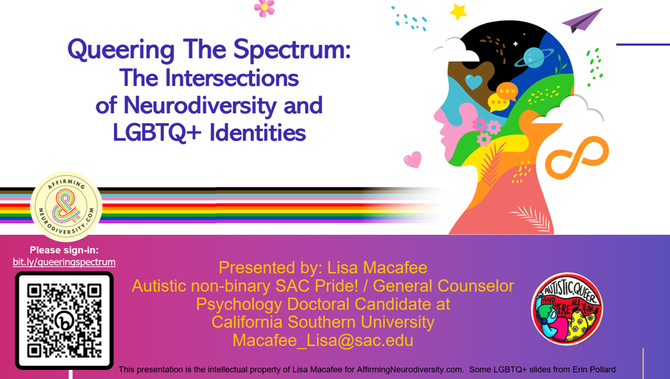
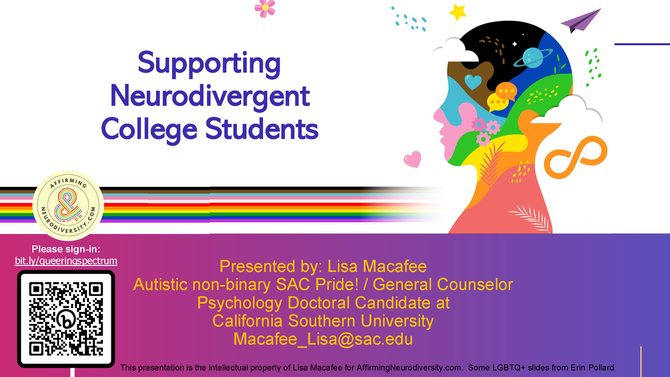
Below are my most recent presentations:
In seeking to understand autism, some people may come to know one individual with autism intimately and think that they understand autism, but as Dr. Stephen Shore says rather eloquently; “if you’ve met one person with autism, you’ve met one person with autism”! It is referred to as the autistic spectrum because there are so many different characteristics that fall under autism, including opposite extremes of one characteristic.
I am writing of how autism has impacted my life in the Blog: Vignettes From Autism. Follow on Instagram or Facebook.
Below are my most recent presentations:
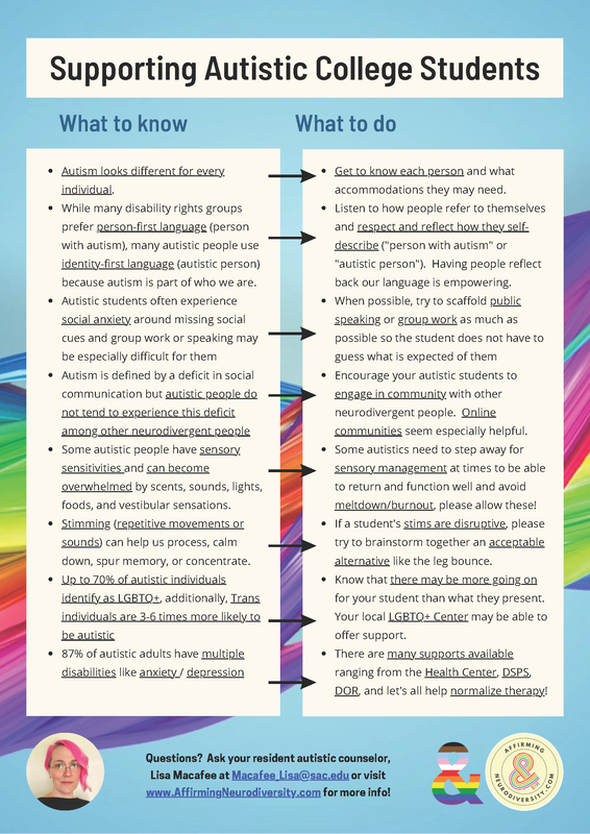
Supporting Autistic College Students PDF (click to download)
The PDF is organized with links on the left for deeper dives into understanding challenges that autistic people face in college, and links to supports to help us be more successful on the right. Please feel free to share with anyone who may find it helpful.
The PDF is organized with links on the left for deeper dives into understanding challenges that autistic people face in college, and links to supports to help us be more successful on the right. Please feel free to share with anyone who may find it helpful.
Here is my video on diagnostic criteria, it is a little older, I will update soon.
Fun fact: I am autistic. I only got my diagnosis at age 37 after getting my children's' diagnosis and thinking that explained all the difficulty of my life. It does. It's wild up in here.
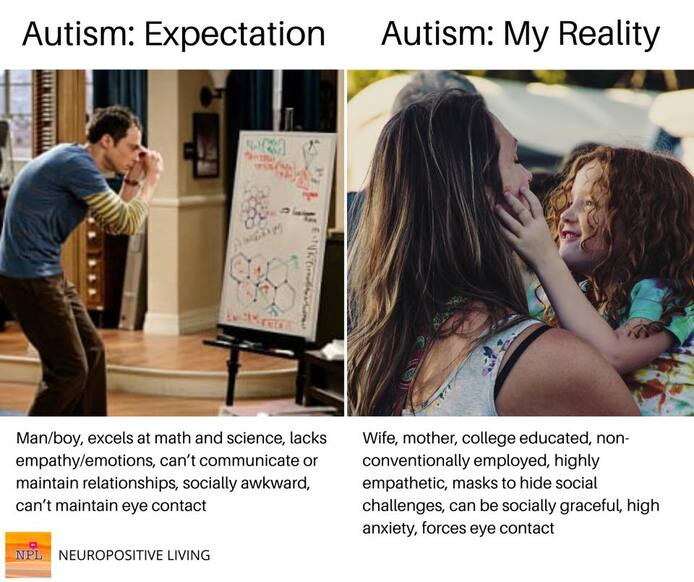
I have been thoroughly disappointed as to how autism is still painted as a little boy's "disease" and mostly leaves out all the adults, women, and trans individuals with autism and their treatment. I find these populations to be the most marginalized and the most vulnerable.
I focus on aspects of autism like the gender diversity, issues common among those with autism, mental health issues, depression and anxiety in adults, and other non-academic issues. As a counselor, these are of pressing concern to me to prevent suicide rates among neurokin.
I have been thoroughly disappointed as to how autism is still painted as a little boy's "disease" and mostly leaves out all the adults, women, and trans individuals with autism and their treatment. I find these populations to be the most marginalized and the most vulnerable.
I focus on aspects of autism like the gender diversity, issues common among those with autism, mental health issues, depression and anxiety in adults, and other non-academic issues. As a counselor, these are of pressing concern to me to prevent suicide rates among neurokin.
|
Carrie Beckwith-Fellows, TEDxVilnius Invisible Diversity: A Story Of Undiagnosed Autism What is autism and why is it difficult to get it diagnosed? In her talk Carrie shares her own personal journey towards diagnosis of autism: why it took 35 years, and what are the root causes for such invisible diversity? Diagnosed as autistic at the age of 35 has allowed Carrie to explore the world again from a new perspective. Aware that a late diagnosis can cause issues with identity, relationships and perception, she launched a website that explores the unique post-diagnosis experience to raise awareness and to support other autists diagnosed as adults. |
Dr. Jac den Houting, TEDxMacquarieUniversity Why everything you know about autism is wrong Being diagnosed with autism is often seen as a tragedy. But for Jac den Houting, it was the best thing that's ever happened to them. As an autistic person, concepts like the Neurodiversity paradigm, the Social Model of Disability, and the Double Empathy Problem were life-changing for Jac. In this talk, Jac combines these ideas with their own personal story to explain why we need to rethink the way that we understand autism. |
Addressing the Characteristics of Autism Spectrum Disorder
The DSM-V describes autism from a deficit perspective with concerns in social communication and rigid behaviors or special interests that cause significant impairment to the individual’s life. I hope that by more people understanding autism, it will lead to helping individuals and their families live more full and happy lives.
The DSM-V describes autism from a deficit perspective with concerns in social communication and rigid behaviors or special interests that cause significant impairment to the individual’s life. I hope that by more people understanding autism, it will lead to helping individuals and their families live more full and happy lives.
Click on the icons below for more information...

|
|
|


|

|

|

|